AI TOP ATOM vs. DGX Spark: what are the differences? real?
A GIGABYTE AI TOP ATOM and a DGX Spark from NVIDIA are built around the same GB10 chip and the same 128 GB of memory. Our measurements are at most 4.3% different from those published for the DGX Spark with llama.cpp, and at most 2% different with Ollama. GIGABYTE provides its own chassis, in the same one-liter form factor as the Founders Edition, its cooling system, and its six references. During 2 hours of continuous load, speed remained stable, with no imposed slowdown.
The DGX Spark from NVIDIA and GIGABYTE’s AI TOP ATOM are built around the same GB10 chip. What really changes? On our AI TOP ATOM, kindly provided by GIGABYTE, we reran three sets of measurements published for the DGX Spark, then measured its sustained-load performance for 1 and 2 hours, its temperatures and SSD, and checked its ports. Reference prices and our buying advice follow.
#Same NVIDIA GB10 chip, GIGABYTE design
The DGX Spark is a NVIDIA platform. Its GB10 chip combines 20 Arm cores and a Blackwell-generation GPU, which share 128 GB of memory advertised at 273 GB/s. NVIDIA also provides the DGX OS, driver, and CUDA. The DGX Spark sold by NVIDIA is called the Founders Edition. Other manufacturers, including GIGABYTE, offer their own machine on the same foundation.
This separation structures the entire guide. What comes from NVIDIA applies to all GB10 machines: the next section verifies this with measurements. What comes from GIGABYTE is assessed based on the chassis, cooling, storage, models, and warranty. StorageReview, an American hardware testing site, writes that because all these machines share the same GB10 platform, the gap in AI performance remains narrow.
| Item | Provided by | On our AI TOP ATOM |
|---|---|---|
| GB10 chip: 20 Arm cores, Blackwell GPU | NVIDIA | Speeds within 5% of the published figures (next section) |
| 128 GB unified memory, 273 GB/s | NVIDIA (platform) | The system sees 121.7 GB; some of it is reserved for startup |
| DGX OS, driver, CUDA | NVIDIA | DGX OS 7.5.0, driver 580.159.03, CUDA 13.0 |
| 150 × 150 × 50.5 mm form factor and 1.2 kg | Same format as the Founders Edition | Matte-black enclosure, slatted front with no port or button |
| Cooling and finish | GIGABYTE | Heatsink, copper plates, heat pipes, and two fans, according to ServeTheHome |
| SSD: capacity and PCIe generation | GIGABYTE (depending on the model) | 4 TB Samsung, verified PCIe 5.0 (32 GT/s over 4 lanes) |
| 240 W USB-C power supply | GIGABYTE (adapter included) | NVIDIA requires using the included power supply |
| Models, prices, warranty | GIGABYTE and retailers | See the references and pricing sections |
#The same speeds as the DGX Spark: three checks
To compare the ATOM with the DGX Spark benchmarks, we reran three published measurements for that machine using the same tool. For llama.cpp and Ollama, the version and settings were also the same; for vLLM, the version and command were not published. If our ATOM produces the same figures, it delivers the same performance as the reference.
#Method and units
Each llama.cpp speed is the average of 5 repetitions, with a standard deviation below 3% (standard deviation measures the spread of the repetitions). Read speed is how fast the machine takes in your text before responding. Write speed is how fast the response appears.
Both are measured in tokens per second (tok/s); a token is a piece of a word, roughly two-thirds of a word in French. Memory and disk throughput are shown in GB and GB/s, as Linux displays them: 1 GB = 1,024 MB.
The protocol was fixed before the first measurement. Each test added afterward is described in a dated addendum written before the test. The method, the dated list of addenda, and the data from our tables are published on our methodology page.
#With llama.cpp: within 4.3%
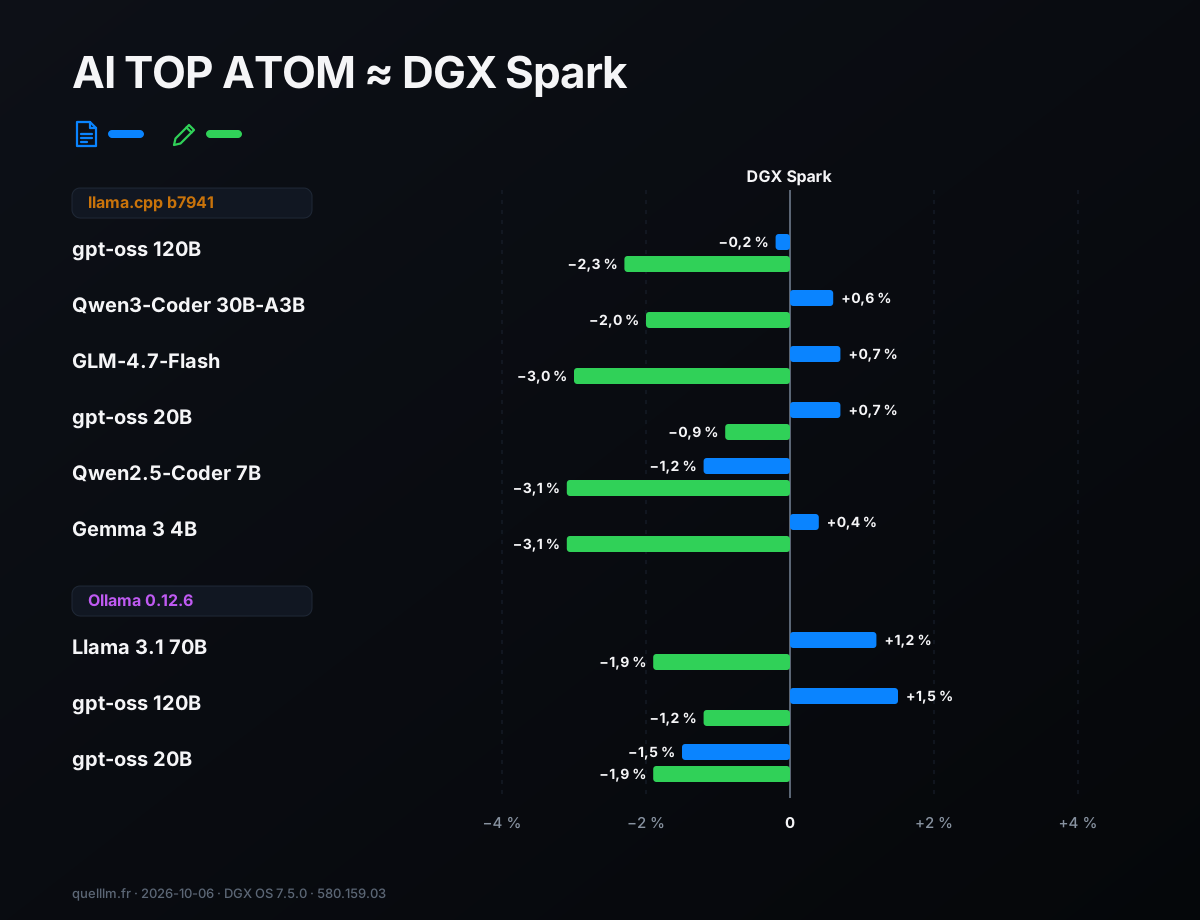
llama.cpp is a widely used open-source engine for running models locally. The project publishes a reference table for the DGX Spark, using build 7941 (the software version number), in February 2026. We compiled the same build and ran the same command on six models and five context depths, for a total of 60 measurement points. The context is the text already present in memory: from 0 to 32 768 tokens.
Result: read speed is identical within 2.3%, with a median difference of +0.3%. Write speed remains at the same level, with a median difference of −2.8% (4.3% at most). For gpt-oss 120B, reading with an empty context matches the reference: 2 443.9 tok/s on both sides. The reference table is from an older driver (580.95.05) than ours (580.159.03).
#With the official Ollama script: within 2%
Ollama published its own DGX Spark measurements in October 2025, using version 0.12.6 and driver 580.95.05. We used the same version and script, with 10 runs and a temperature of 0. The three published models produce results within 2% of one another, for both reading and writing.
| Model | Read: ours / published | Gap | Write: our measurement / published | Gap |
|---|---|---|---|---|
| gpt-oss 20B | 3 175,0 / 3 224 | −1,5 % | 57,18 / 58,27 | −1,9 % |
| gpt-oss 120B | 1 186,8 / 1 169 | +1,5 % | 40,65 / 41,14 | −1,2 % |
| Llama 3.1 70B | 1 933,6 / 1 911 | +1,2 % | 4,34 / 4,423 | −1,9 % |
#With vLLM: same ballpark, different engine
StorageReview measured the ATOM on March 3, 2026, with vLLM, a server designed to respond to several people at once, on gpt-oss 120B. StorageReview publishes neither the vLLM version nor the exact command. We reran its three scenarios with vLLM 26.09, for 1 and for 64 users.
Our throughput is in the same range as its results, above or below depending on the scenario. With one user, in the scenario where the machine reads 4,096 tokens and writes 512, we get a total of 304.4 tokens per second, compared with 304.6 for StorageReview.
With 64 users, in the balanced scenario (256 tokens read, 256 written), we reach 695 tokens per second, versus 650. Since the vLLM version is not the same, we present these figures as being in the same ballpark, not as a comparison of machines. During these tests, no requests were interrupted.
In short: with llama.cpp and Ollama, two widely used local engines, the ATOM delivers performance within 5% of a DGX Spark. For each model’s speed on this chip, see our first guide in the series.
#What GIGABYTE provides: chassis, cooling, models
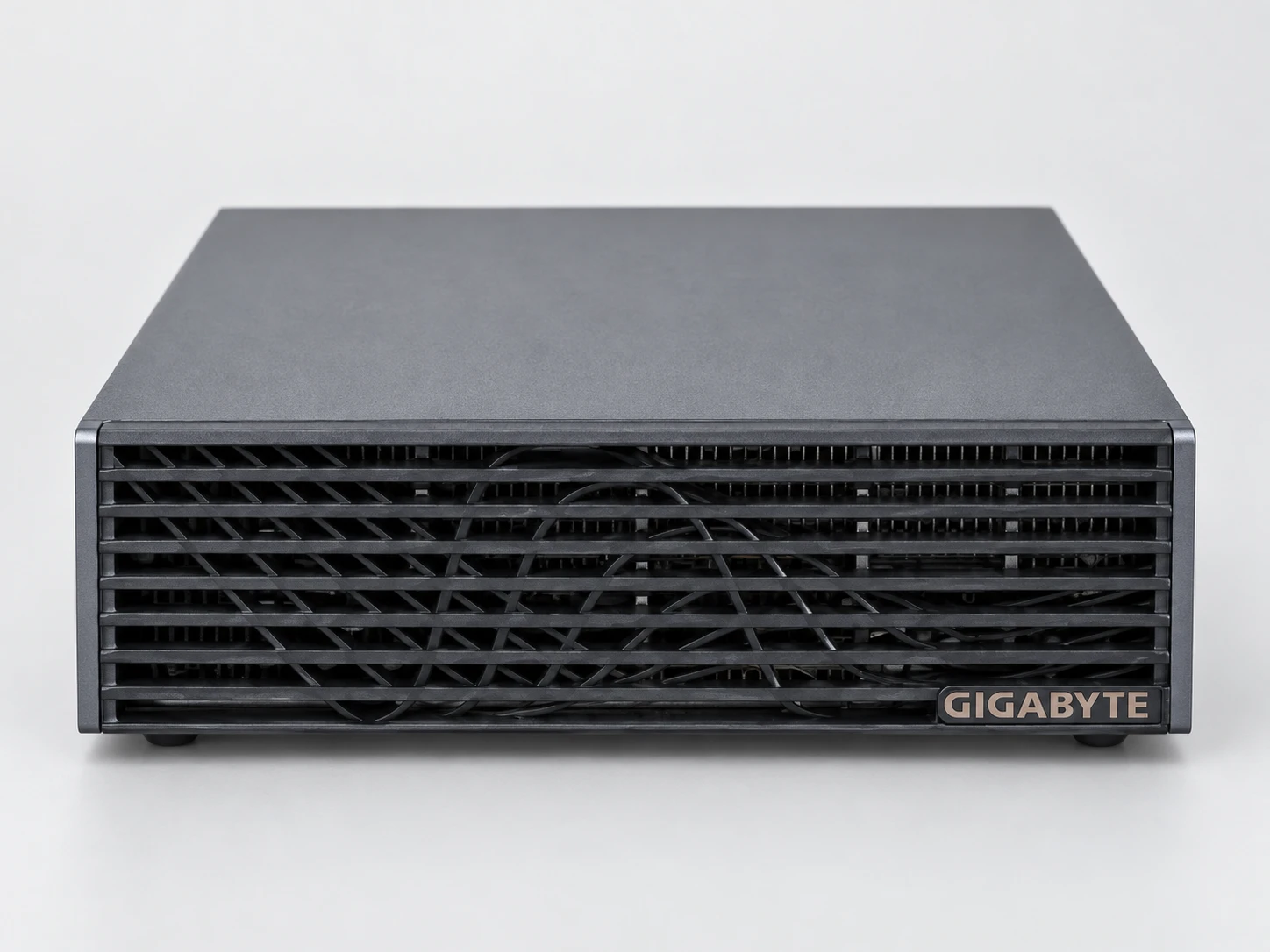
The AI TOP ATOM measures 150 × 150 × 50.5 mm and weighs 1.2 kg, for a volume of approximately one liter: that is the Founders Edition form factor. The case is matte black. The front panel has slats with a wavy pattern and no ports or buttons: everything plugs in at the back.
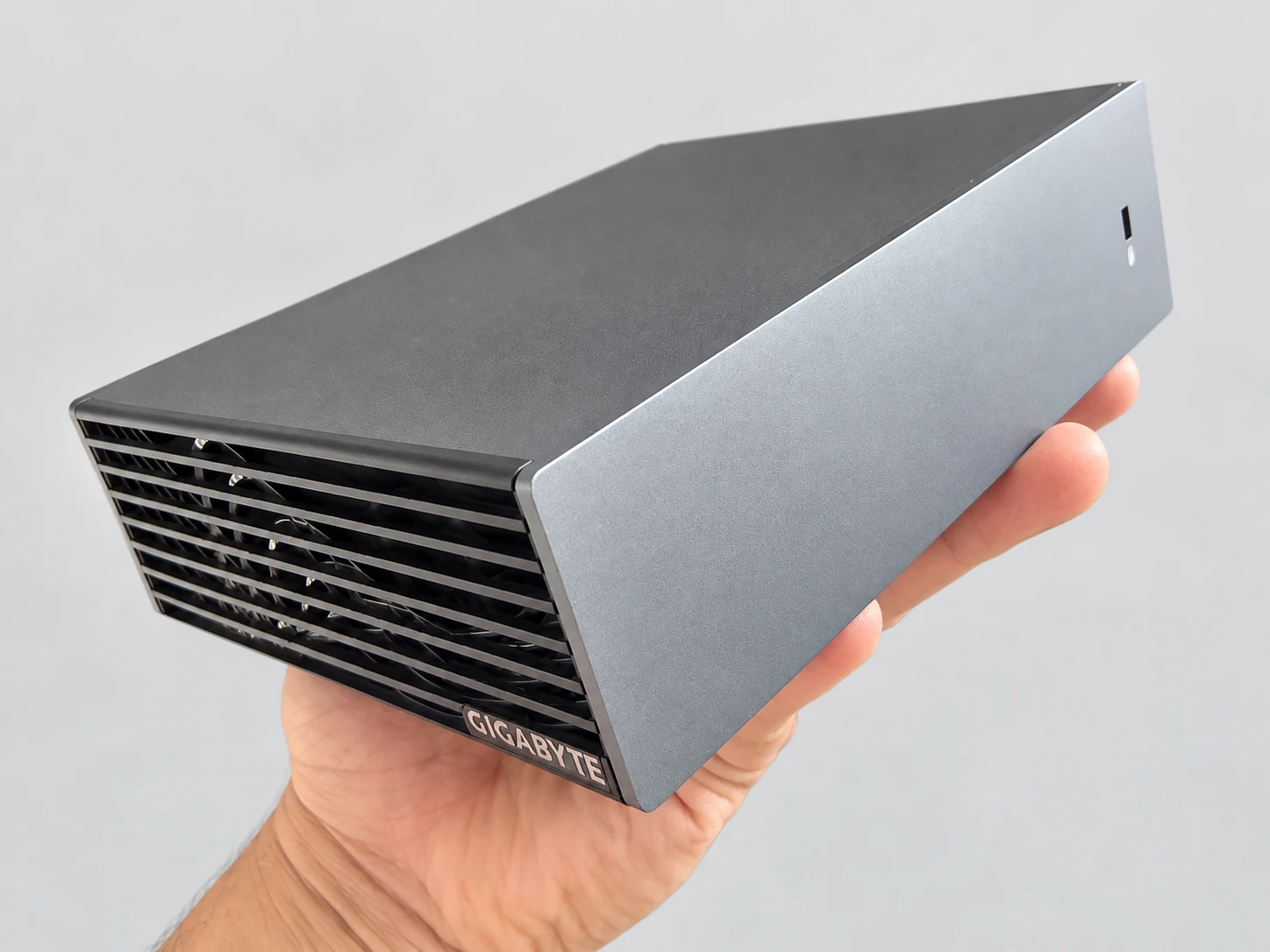
ServeTheHome opened the machine. It describes a large heatsink with copper plates over the chips and heat pipes, cooled by two Delta fans. StorageReview compared five GB10 machines in January 2026. The GIGABYTE reaches a peak of 87 to 88 °C under maximum load, like the Founders Edition and the Dell machine.
StorageReview ranks it among the best cooling profiles, with one of the highest GPU power levels. After more than an hour of heat-up, ServeTheHome finds the ATOM comparable to the NVIDIA DGX Spark, with a slight advantage in several of its AI tests.
Peter Falkingham, who has been using an ATOM since July 2026 for a university lab, describes it as nearly silent in his test.
#Six references, with a choice of SSD
GIGABYTE's product page lists six models, from ATAGB10-9000 to ATAGB10-9005. The table shows the ones we were able to verify.
| Reference | Memory | SSD |
|---|---|---|
| ATAGB10-9000 (our unit) | 128 GB | 4 TB over PCIe 5.0 |
| ATAGB10-9001 | 128 GB | 4 TB over PCIe 4.0 |
| ATAGB10-9002 | 128 GB | 1 TB PCIe 4.0 |
| ATAGB10-9003 to 9005 | 128 GB or 64 GB | 2 TB or 1 TB over PCIe 4.0 (not verified reference by reference) |
On the 9000, the SSD is a Samsung from the PM9E1 family, the same model as the Founders Edition’s according to StorageReview. It is an M.2 2242 module. According to ServeTheHome, it is the only component the user can replace.
#Power supply, box, and warranty
The 240 W adapter plugs into the USB-C port reserved for power. NVIDIA recommends using the supplied power supply for optimal performance. The box contains the machine, adapter, and power cord. A QSFP cable for connecting two machines is sold separately by GIGABYTE: €94.04 including VAT at the official AORUS store (recorded October 8, 2026).
For the warranty, GIGABYTE's manual states that the duration is specified on the product website or its label. LDLC announces 5 years of warranty coverage for the 9000 (recorded on 8 October 2026). Check the duration on the reseller's product page before buying.
#Ports and connectivity
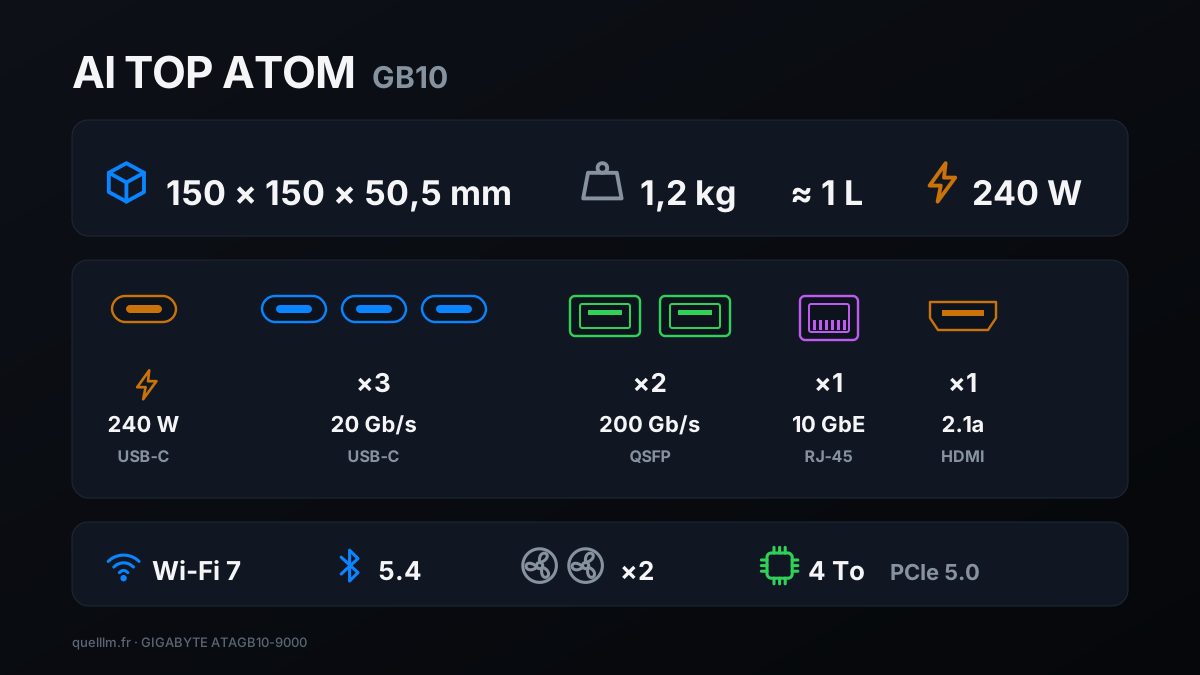
The list reproduces GIGABYTE’s specifications, and the NVIDIA Founders Edition specifications list the same ports. On our unit, we verified the wired network and SSD link, and identified the Wi-Fi module.
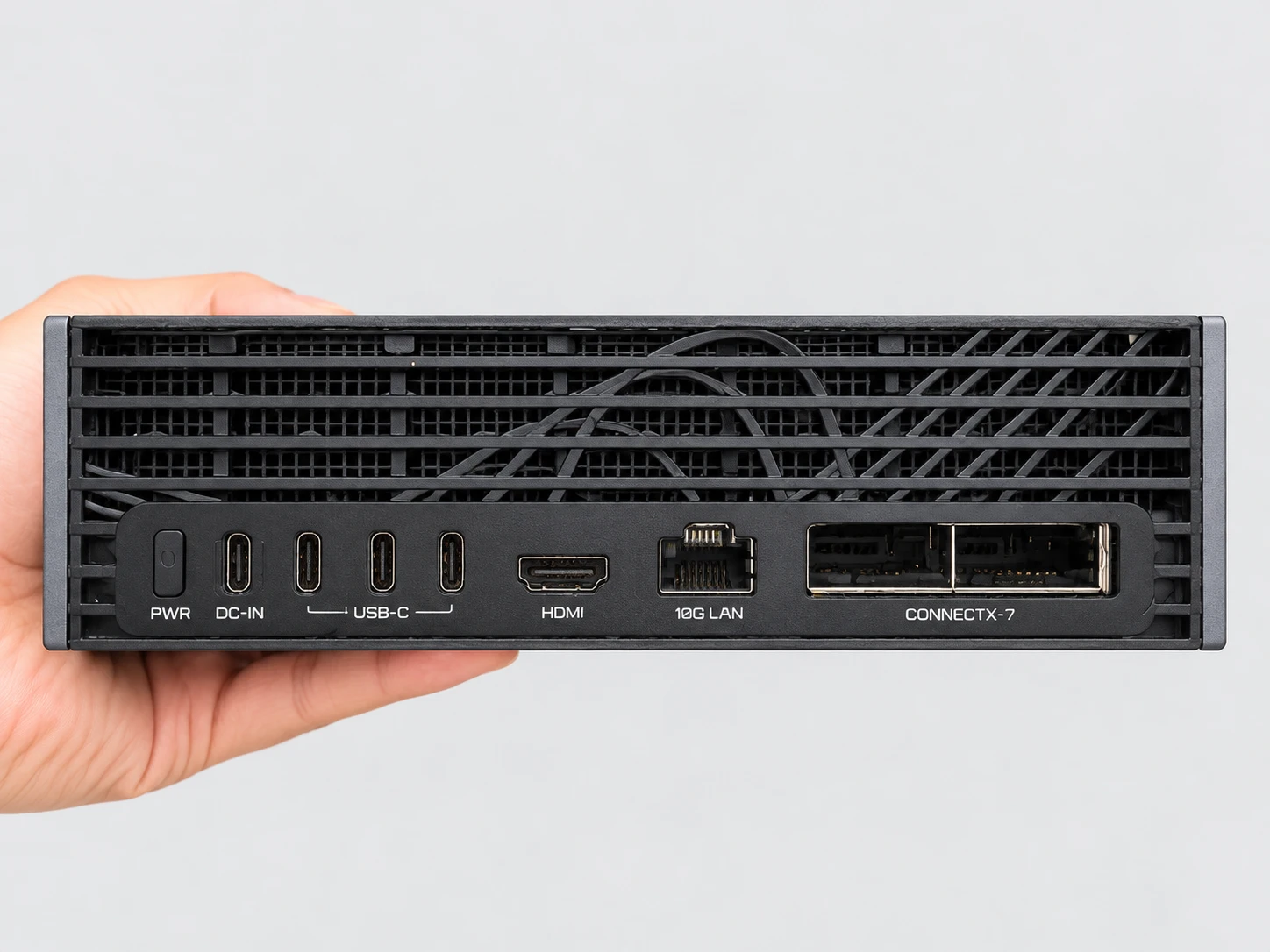
- Power supply
- A USB-C port dedicated to power, with the included 240 W adapter.
- USB
- Three 20 Gb/s USB-C ports (USB 3.2 Gen 2x2) for drives and accessories.
- Wired network
- One 10 GbE RJ-45 port. On our unit, the negotiated link is 10 Gb/s.
- High-speed networking
- Two QSFP ports (NVIDIA ConnectX-7 card, 200 Gb/s) for connecting multiple machines. We did not test this link.
- Video
- One HDMI 2.1a output with multichannel audio.
- Wireless
- Wi-Fi 7 and Bluetooth 5.4. Our system identifies a MediaTek MT7925 chip.
#Sustained load: 1 hour and 2 hours continuously
A compact machine must handle the load without slowing down. A slowdown imposed by heat or a power limit is called throttling. We ran the ATOM continuously with vLLM 26.09. Each session is divided into batches: a batch is a group of requests sent one after another. During this time, we recorded the GPU clock, power, temperature, and the throttling reasons reported by the driver every second.
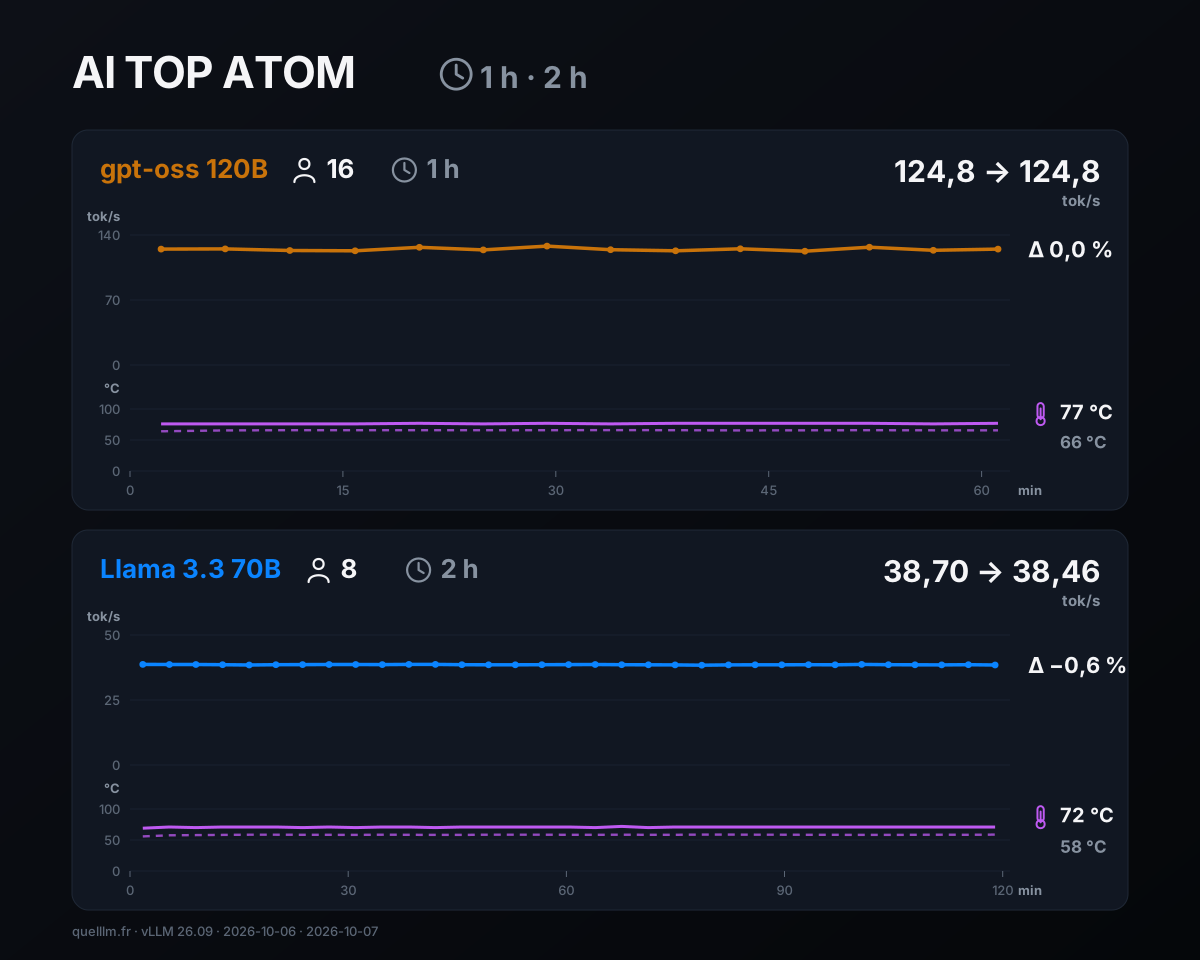
| Session | Requests | Throughput: first → last slice | Drift | GPU temperature | Bridage |
|---|---|---|---|---|---|
| 1 h, gpt-oss 120B, 16 users, 14 shards | 896, no failures | 124.8 → 124.8 (from 122.6 to 128.1) | 0,0 % | 77 °C / 66 °C | None |
| 2 h, Llama 3.3 70B NVFP4, 8 users, 33 batches | 1,056, no failures | 38.70 → 38.46 (from 38.40 to 38.70) | −0,6 % | 72 °C / 58 °C | None |
For one hour, 16 users continuously sent requests containing 4,096 tokens, with 512-token responses. The 14 batches of 64 requests delivered nearly identical throughput, from 122.6 to 128.1 tok/s in total, and both the first and last reached 124.8 tok/s. Each person saw their response being written at about 8 tok/s. The GPU clock had a median of 2,509 MHz during this session.
For two hours, 8 users worked on Llama 3.3 70B in NVFP4 format, a compressed format of NVIDIA, with 1,024 tokens read and 256 written per request. Total throughput remained between 38.40 and 38.70 tok/s across 33 batches of 32 requests.
Drift is −0.6% between the first and last batch, and −0.2% when comparing the medians of the first five and last five. Each person saw their response being written at about 5.1 tok/s, and the first word arrived in 2.8 s (median). The GPU clock had a median of 2,528 MHz.
The driver reported no throttling reason during either session: the recorded value remained zero, second after second. The GPU reached a maximum of 77 °C with 16 users and 72 °C with 8 users. The system sensors’ hottest zone reached 87 °C during the first session and 80 °C during the second.
During the second session, the SSD reached a maximum of 49 °C. The firmware does not name these zones, so we do not attribute them to the processor. For comparison, StorageReview recorded peak temperatures of 87 to 88 °C under maximum load on the Founders Edition, the Dell machine, and the GIGABYTE.
#At idle
After 20 minutes at idle, we recorded the machine for 30 minutes. The GPU consumes an average of 10.4 W (from 10.2 to 11.0 W) and remains between 35 and 36 °C. The hottest area among the system sensors reaches no more than 46 °C, and the SSD remains between 34 and 35 °C. No reason for throttling was reported.
The reported power is the GPU's, as measured by its sensors; it does not represent the machine's total power consumption. The ambient temperature was not recorded. The one-hour session took place in the early evening, and the 2-hour session at night, when the room was probably cooler.
#The SSD: 13 GB/s read speed, 1.28 million IOPS
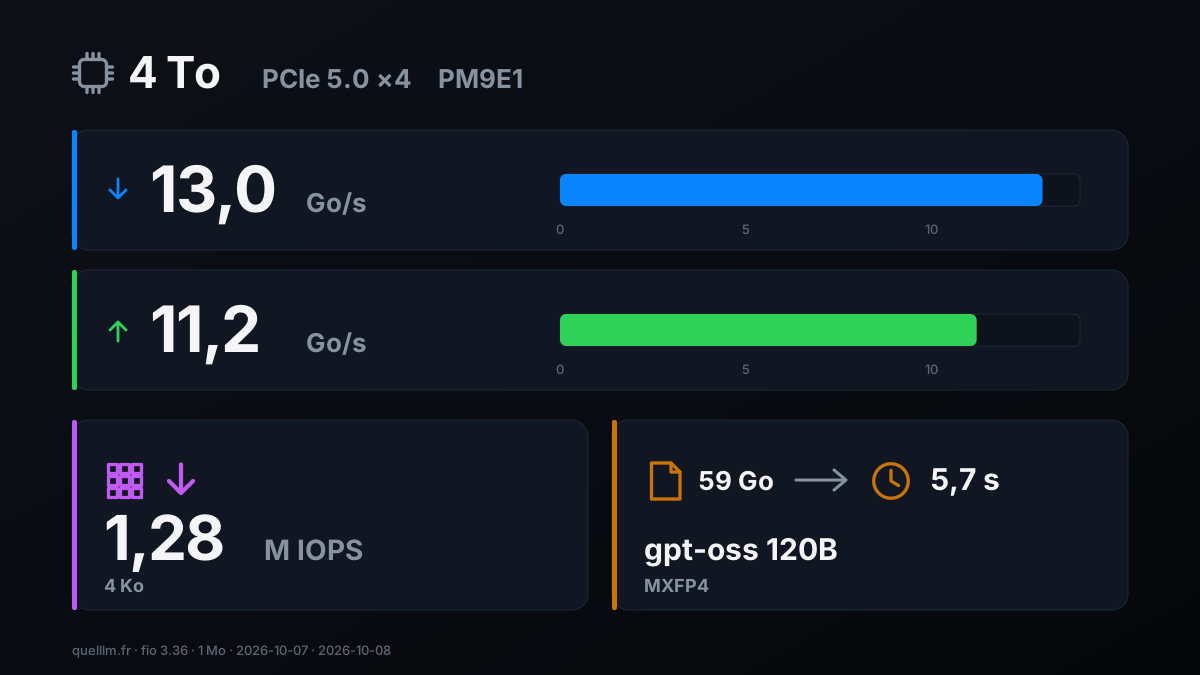
The 9000 reference model contains a 4 TB Samsung MZALC4T0HBL1 SSD from the PM9E1 family. The system confirms a PCIe 5.0 link: 32 GT/s over 4 lanes. PCIe is the link between the SSD and the chip; version 5.0 is twice as fast as 4.0.
We measured it with fio 3.36 on a 64 GB file that was fully written before reading, using direct access—that is, without going through the system cache. IOPS is the number of read or write operations per second.
| Test | Result |
|---|---|
| Sequential read, 1 MB blocks, 1 task | 13.0 GB/s (12.99 with io_uring, 13.37 with libaio, two Linux disk-access methods) |
| Random read, 4 KB blocks, 4 jobs | 1.28 million IOPS with io_uring, 1.19 million with libaio (about 4.9 GB/s with io_uring) |
| Burst sequential write, 1 MB blocks, new 32 GB file, drive idle | 11.2 GB/s |
| Reading the gpt-oss 120B file (59 GB) | 5,7 s |
StorageReview published 11.0 to 11.6 GB/s read and 12.2 GB/s write speeds using another tool (gdsio) and the same SSD model. Our values are in the same range, with slightly higher read performance. In practice, a large model loads in a few seconds: the gpt-oss 120B file, 59 GB in size, was read in 5.7 s.
On the 9000, you get the 4 TB Founders Edition SSD: it is the same model, so it does not distinguish the ATOM from the NVIDIA model. The difference exists between the GIGABYTE models: the 9000 has a PCIe 5.0 SSD, while the 9001 and 9002 have PCIe 4.0 SSDs. The SSD measurements concern the 9000 model.
#64 or 128 GB?
On October 2, 2026, NVIDIA announced a 64 GB DGX Spark for models with up to 100 billion parameters, available October 23 from Acer, ASUS, Dell, GIGABYTE, HP, and MSI, starting at $4,999. GIGABYTE confirmed on October 5 a 64 GB AI TOP ATOM with the same design. Availability in France is not confirmed as of today. We did not measure it.
Our measurements from the first guide in the series allow us to calculate this. Models up to Qwen3-Coder 30B-A3B use less than 35 GB with 32 768 tokens of context and would fit in 64 GB. Llama 3.3 70B (51 GB) would be at the limit. gpt-oss 120B (62 GB) and larger models would not fit. At the same bandwidth—which still needs to be verified—the speeds should be similar.
To run a model with more than 100 billion parameters on a single machine, the 128 GB version is required. The six models listed on GIGABYTE’s page let you choose your memory and SSD.
#Price by model (recorded October 8, 2026)
GB10 prices change every week: check them before buying. Here is what we recorded in France on October 8, 2026, including tax. Always compare the same model: the 9001 (PCIe 4.0) and the 9000 (PCIe 5.0) are not the same machine.
| Marchand | Reference | Price including tax | Displayed availability |
|---|---|---|---|
| Official AORUS store | 9001 (4 TB on PCIe 4.0) | 6 346,27 € | Sold out |
| Amazon.fr, sold by Amazon UK | 9001 (4 TB on PCIe 4.0) | Variable price; check Amazon.fr | 1 unit |
| LDLC | 9000 (4 TB on PCIe 5.0) | 7 999,95 € | Rupture |
| Rue du Commerce, third-party sellers | 9000 (4 TB on PCIe 5.0) | Starting at €7,999.95 (3 offers) | Depending on the seller |
| Senetic.fr | 9000 (4 TB on PCIe 5.0) | 9 022,08 € | 5 units |
Materiel.net listed the same price as LDLC for the 9000, also out of stock. For comparison, on the same day, the MSI EdgeXpert, another GB10 machine, was listed at €6,599.95 at Materiel.net and was also out of stock; PNY’s DGX Spark was no longer offered there or at LDLC. A listed price for an unavailable machine is not a purchase price: check availability too.
#What we did not measure
- Comparison with the DGX Spark
- The comparison is based on measurements published for the DGX Spark, rerun on the ATOM with the specified software versions.
- Noise
- The noise assessment cited on this page comes from Peter Falkingham’s test.
- Power consumption of the entire machine
- The power figures on this page are for the GPU alone. A future guide in the series covers power consumption.
- Room temperature
- The published temperatures come from the machine’s built-in sensors.
- The link between two machines
- The two QSFP ports (200 Gb/s) were not tested.
- The other references and the 64 GB version
- The measurements cover the 128 GB ATAGB10-9000 model.
This page will be updated if a new version of DGX OS, the firmware, or our tools changes these results; each correction will be dated.
#Who the AI TOP ATOM is right for
The following comes from our measurements of the 9000 reference unit and our price checks from October 8, 2026.
- You want GB10 reference performance in a polished enclosure
- The 9000 comes within 4.3% at most of the published DGX Spark speeds, with a 4 TB PCIe 5.0 SSD measured at 13 GB/s for reads.
- … you keep the machine on your desk
- It fits in one liter, weighs 1.2 kg, and has a clean front panel. At idle, the GPU uses approximately 10 W.
- … you serve a team or AI agents
- One hour with 16 users on gpt-oss 120B, then two hours with 8 users on Llama 3.3 70B: speed remained stable (drift of 0.0% and −0.6%), with no throttling.
- … you want to pay less without changing the chip
- The 9001, with a 4 TB PCIe 4.0 SSD, was listed at €6,346.27 at the official AORUS store on October 8, 2026, was out of stock there, and was in stock on Amazon.fr. It has the same chip and the same 128 GB; the measurements on this page concern the 9000 model.
- … your models use less than 35 GB with their context
- The 64 GB version, announced for October 23, 2026, should be sufficient (calculation based on our first guide, not measured on this version). Wait for its availability and price.
- … you want to connect several machines
- The two QSFP ports (200 Gb/s) are intended for this use. GIGABYTE sells the cable separately.
#FAQ
Is the AI TOP ATOM as fast as a DGX Spark from NVIDIA?+
What concretely changes between an ATOM and a Founders Edition?+
Does the AI TOP ATOM slow down during extended workloads?+
Which model should you choose: 9000, 9001, or 9002?+
Should you wait for the 64 GB version?+
Feedback, an error, or a clarification? Let us know—it improves the guide for everyone.